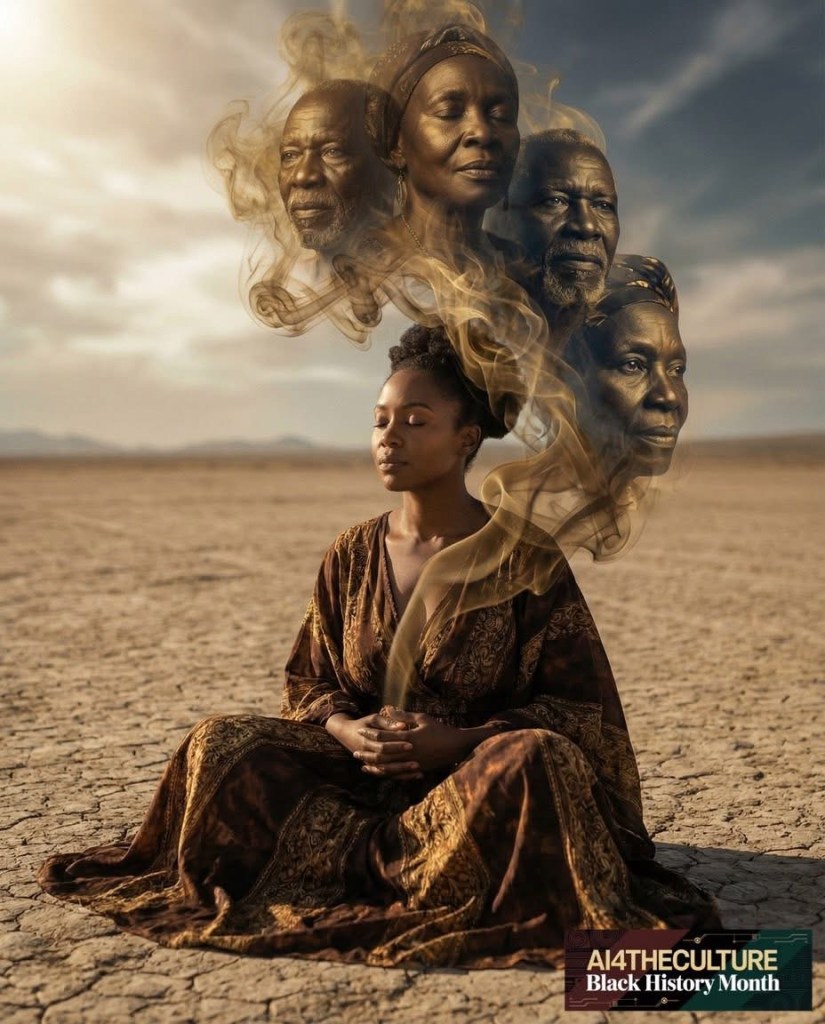
She sits in the middle of dry land.
Cracked earth. No shortcuts. No shade. The kind of place where nothing grows unless it decides to. Her hands rest gently in her lap, not folded in prayer, not clenched in defense just open enough to receive what she’s been carrying her whole life.
Her eyes are closed.
That’s important.
Because this isn’t about what she sees.
It’s about what she remembers.
They rise from her like smoke faces she didn’t ask for but could never escape. Elders. Mothers. Fathers. The ones who survived so quietly the world mistook their endurance for ease. Their expressions are calm, almost knowing, like they’ve been waiting for her to finally sit still long enough to feel them.
No one warned her they would live inside her.
Not as ghosts.
As instructions.
She learned early how to be strong without complaint. How to swallow pain and call it maturity. How to keep going even when grief sat heavy in her chest with nowhere to go. She learned how to be grateful and silent at the same time.
That’s what survival looks like when it’s passed down.
The land around her is barren, but she isn’t. She is full overflowing, actually. Full of stories she didn’t get to choose. Full of resilience that costs more than anyone ever admits. Full of a tenderness that somehow survived everything meant to harden her.
This is the part people don’t like to talk about.
Healing isn’t gentle at first.
It’s loud internally.
It’s uncomfortable.
It asks questions you don’t want to answer.
She closes her eyes because she knows if she opens them too soon, she might run. And she’s tired of running from what made her.
The ancestors don’t speak. They don’t need to. Their presence alone is a reminder: you are not alone, but you are responsible now.
That’s the unfiltered truth.
We carry them, but we also decide what continues. We determine what pain gets honored and which pain gets released. We decide whether survival stays the legacy or whether wholeness finally gets a turn.
This blog, this space is for women like her. Like us. The ones learning how to sit with their history without letting it suffocate them. The ones unlearning silence. The ones brave enough to say: just because it was normalized doesn’t mean it was okay.
She inhales.
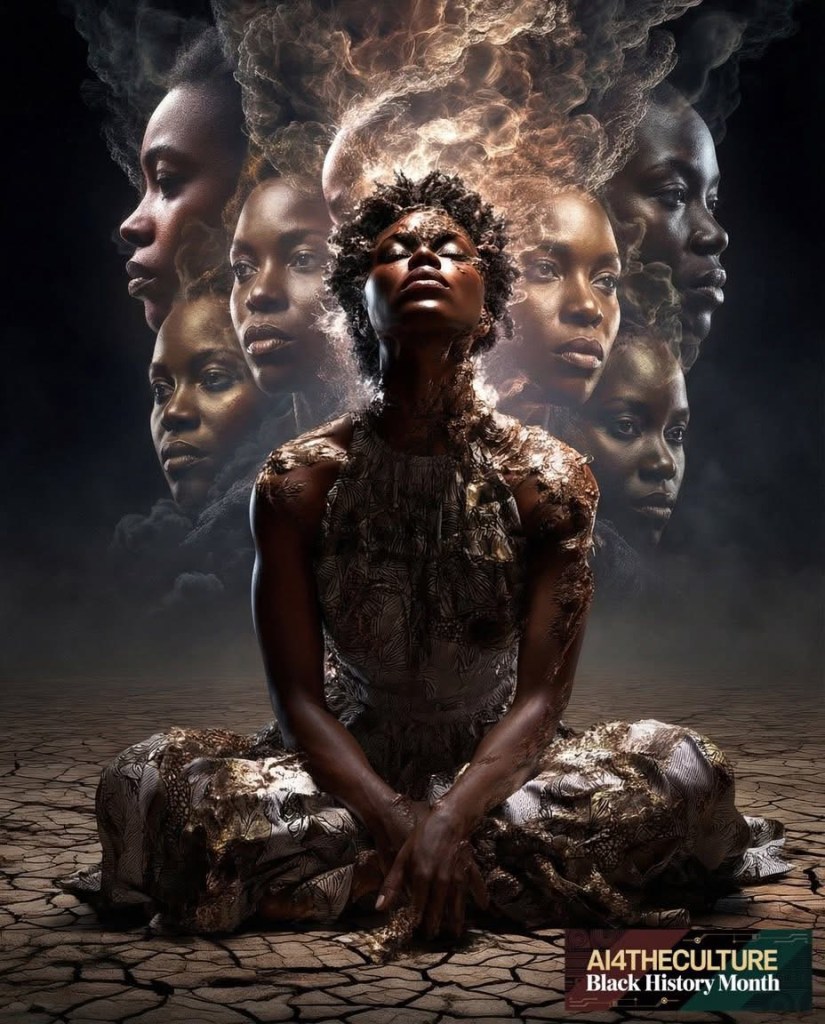
The smoke doesn’t disappear.
It settles.
Not as a burden but as grounding.
And when she opens her eyes, she won’t be the same woman who sat down.
That’s how it begins.
Some stories don’t end.
They evolve.
If this stirred something in you, it’s because your ancestors are talking too.
What did you inherit that you’re finally questioning?
What are you choosing to carry forward, and what stops with you?
Say it here.
This space was made for truth.

 Treasurable Life
Leave a comment